

Angola: A Letter from Our CEO

I recently sat down for lunch in Washington, D.C. with Steve Boyes, Rainforest Trust implementing partner, founder of Angola’s Fundação Lisima, National Geographic Explorer, and the main force behind the exploration and protection of the headwaters of the Okavango Delta. Steve is tall, lean, and exuberantly whiskered, and he shared his extraordinarily ambitious conservation vision with such fluency that I was surprised he managed to eat his lunch!
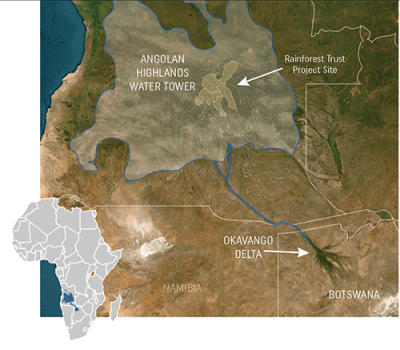
Eight years ago, Paul Allen, my then boss at Vulcan Inc., read about Steve’s exploration of the vast intact Miombo woodlands and high altitude peatlands and source lakes in Angola’s central highlands. Paul loved elephants and the Okavango Delta, whose wider landscape harbors half of the entire world’s population of elephants, and asked me to investigate Steve’s claim that this “Angola Water Tower” was critical to the Delta as well as to the Zambezi, Southern Africa’s largest river.
Much of Southern Africa is dry, including the deserts of the Skeleton Coast and the Kalahari of Botswana, Namibia, and South Africa. Yet in the middle of the Kalahari is a vast oasis that provides life-sustaining water all year long to one of the world’s greatest wildlife spectacles, the Okavango Delta. Ninety-five percent of the delta’s water comes not from Botswana or Namibia, the countries that have so ably harnessed its tourism potential, but from the highlands of neighboring Angola, a nation with little tourism that has only recently emerged from a bloody independence struggle and civil war. As in Brazil’s Pantanal, the Okavango’s New World counterpart, the delta’s waters are threatened by climate change, plans for commercial agriculture, and deforestation in Angola.

Angola Water Tower, photo courtesy of Fundação Lisima
On Paul’s instructions, I flew to Angola to join a “mini-mission” organized and led by the Minister of Environment of Angola and the International Conservation Caucus Foundation. We visited many parks and crossed paths with Steve Boyes at the base of the Water Tower, the confluence of the Cuito and Cuanavale Rivers where Angola defeated South Africa in the final battle for independence. We didn’t make it to the source lakes and peatlands, as these are accessible only by weeks of canoeing (or, more recently, at great expense, by flying helicopters from South Africa). But we confirmed Steve’s vision and gained initial buy-in from the Government of Angola.
Alas, Paul tragically died before we could offer substantial support to Boyes, but when I joined Rainforest Trust I found our conservation team had been in parallel conversations with him. Rainforest Trust was interested in the project not only because of the critical watershed importance to the Okavango Delta and Zambezi River but for two other reasons as well:
-
-
- The Angola Highlands, including the forests surrounding the peatlands and source lakes, is the largest, intact, unprotected expanse of miombo in Africa. Miombo is dry, seasonal forest adapted to Southern Africa’s poor soils and extreme wet and dry seasons. It is the second-largest forest in Africa and harbors a surprising diversity of plants and animals, perhaps because it is an ancient habitat. In Rainforest Trust’s 2021-2025 Strategic Plan, we specifically targeted protecting large, intact areas of miombo, and in 2024 we helped spearhead the global Miombo Partnership to save the forest.
- Steve and his colleagues have identified an extraordinary number of new species to science in the Angola Highlands—over 70 during the past decade, with nearly 300 more still to be described. These include the Horned Baboon Spider (Ceratogyrus attonitifer), Climbing Perch (Microctenopoma steveboyesi, named after Steve), Angolan Rain Frog (Breviceps ombelanonga), Lilliput Pricklyleg (a tiny dragonfly, Porpax sp. nov.), and the Sand-cotton Tree (Cochlospermum adjanyae).
-

Group of Savanna Elephants in the Okavango © Zaruba Ondrej
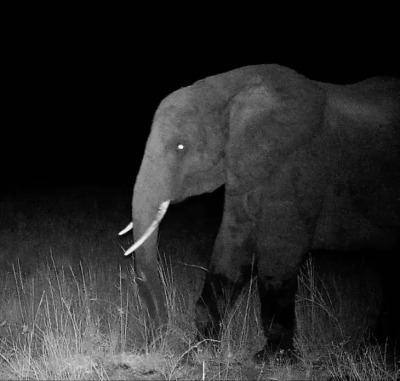
Angola’s large mammal populations have been dramatically reduced through years of civil war, but most species are still present, albeit at low densities, including Cheetahs, African Wild Dogs, various antelope species, and even African Savanna Elephants. Last year the acclaimed filmmaker Wernor Herzog released a mystical documentary called “Ghost Elephants” about Boyes’ search for the last elephant herd in the Angola Highlands.
But in 2020, the gap between Steve’s courageous vision and a practical way to protect one of Earth’s most important unprotected wildernesses was wide: Angola had little tradition of civil society or NGOs and incomplete regulations around community-based protected areas, and the local government, communities, and traditional leaders of the region were not yet fully on board. And there was no clear way to reward Angola for protecting the water for Botswana’s world-class tourism destination.
So Rainforest Trust provided Steve with two small Feasibility Awards to help him create a new Angolan NGO; to build understanding and trust with local communities, leaders, and governments; to plan; and, importantly, to bring on another partner, Conserve Global, a new NGO with staff highly experienced in protected area creation and management but also deeply committed to community stewardship.

Group of Zebras in the Okavango © imageBROKER.com
Finally, last year, Steve’s Fundação Lisima (short for Lisima Lya Mwono or “Source of Life” in the local language, Luchazi) worked with Conserve Global and Rainforest Trust’s Africa team to develop an ambitious but achievable plan. Building on traditional governance, they will create five “Conservation Kingdoms” to formally protect 3.15 million acres of the Water Tower, with more to follow. Initially, protection will be implemented under the authority of local chiefs (or kings). However, I’ve met with Angolan Minister of Environment Ana Paula de Carvalho Pereira four times over the past two years and she has pledged to me that the government will legally formalize this designation as some type of protected area or community conservation area.
Steve never rests. At lunch, he explained that adjacent to the Water Tower is an area of uninhabited miombo that historically was reserved for personal hunting by the local chief, and that this area and this chief see this as a great area to pioneer complete nature protection and responsible tourism development. Rainforest Trust’s new Council Member, Colin Bell, founder of Wilderness Safaris (and probably the individual responsible more than anyone else for the protection of the Okavango through sustainable tourism) is intrigued. And Steve is working on potential long-term funding for management of the new protected areas from a partnership including the Rob Walton Foundation and the philanthropic arm of the De Beers Group.
Rainforest Trust’s role is critical right now. We will be the largest funder of the legal protection of the Lisima Landscape, the catalytic step from vision to long-term management and sustainable development. We’ve pledged $4.5 million, and I invite you to join us in fulfilling Steve’s extraordinary vision. If you are able, I would be hugely grateful for your help to safeguard the waters of the Okavango Delta and protect the largest unprotected miombo woodland in Africa with hundreds of species new to science.
You can learn more about the project by visiting Rainforest Trust’s website, by viewing the documentary, Ghost Elephants, which is currently streaming on Disney, YouTube, and Hulu, or by picking up the June issue of National Geographic magazine, which has a wonderful article about Steve and the Water Tower.
Thank you for caring deeply about species and our planet—and maybe for your contribution to this project. It is so exciting finally to see Steve’s (and Paul’s) vision becoming real!
With thanks and celebration,
James C. Deutsch
CEO, Rainforest Trust

Angola Water Tower, photo courtesy of Fundação Lisima

Sign up to receive the latest updates
"*" indicates required fields
The Latest

Rainforest Trust Surpasses 70 Million Acres Protected Worldwide; Organization adds 10 million protected acres in just eight months

From Landmines to Rainforest Guardians

Rainforest Trust Announces $10 Million Commitment to Conservation in Madagascar
Angola: A Letter from Our CEO

Madagascar Designates Protected Landscape in Tsinjoarivo’s Montane Rainforest

Why We Support Indigenous-led Conservation

Study Reveals Thousands of Previously Undocumented Species in Ecuador’s Chocó
