

A Message From Our CEO: Carrying on George Schaller’s Mission

One of the books I enjoyed most this summer was “Homesick for a World Unknown,” Miriam Horn’s new biography of George Schaller, published with support from Rainforest Trust board member Edith McBean. Schaller is arguably the 20th century’s greatest field biologist. I worked with him at the Wildlife Conservation Society before he went on to co-found Panthera (both are Rainforest Trust partners). He carried out the first field studies of Mountain Gorillas in the Congo, Lions in the Serengeti, Jaguars in the Pantanal, Snow Leopards in Tibet, and Giant Pandas in China. In each case, Schaller’s work catalyzed large-scale conservation action, often the creation of a protected area—sometimes a vast protected area—to safeguard the species’ habitat.
What most fascinated me was how Schaller translated his love of, respect for, and fascination with the inner lives of large mammals into powerful and persuasive arguments for conservation, while at the same time respecting local communities and governments. The book’s discussion of his study of Giant Pandas is at first depressing: when he arrived in China, the species seemed to be declining inexorably, government conservation efforts were not succeeding, and individual pandas were suffering. Schaller spent years observing and reporting disturbing facts, objectively and critically. Government officials were so convinced of his commitment to the animals and his lack of any political agenda that they continued to offer him unique access and eventually followed his advice. Today, pandas are thriving.
Though I spent years in the field studying Uganda Kob antelope and Malawi Cichlid fishes, I was never going to be the next George Schaller. But I, too, came to conservation in part through a concern for the inner lives of animals. My undergraduate philosophy thesis was on whether people, animals, or machines could be said to be conscious and how we would know. I moved from philosophy to anthropology to zoology because I thought that empirical science would produce the answers to these questions more readily than armchair thinking. And then I moved from science to conservation because asking questions wasn’t enough—I needed to do something with the answers.

Uganda Kob antelope © Josia Aaron
When I was an undergraduate in the 1980s, scientists’ and the public’s attitudes toward animal consciousness and animal rights were recovering from the collective wrong turn of behaviorism. That theory held that attributing mental states such as beliefs and desires to animals was unjustified and unscientific. Schaller’s work, along with that of Rainforest Trust board member Ed Wilson and, of course, Jane Goodall, helped the world see the folly of this theory, but we still have a long way to go to make right our relationships with animals. This year, an official government panel in the UK concluded that invertebrates such as lobsters, crabs, and octopuses are probably sentient.
Rainforest Trust’s donors and partners support our mission of protecting critical habitat for a wide variety of reasons:
- Some are committed to preventing species extinction because that is the one conservation loss that cannot be undone.
- Some see aesthetic and practical value in preserving large, intact, wild places.
- Some believe that global cycles, such as carbon and water, must be maintained by tropical forests for the future of our planet and our species.
- Some believe that formalizing the traditional guardianship of Indigenous Peoples and local communities is not only morally right but the most effective way to sustain conservation success.

James encounters a Cheetah in Serengeti National Park, Tanzania, in 2005
But many of our donors (and partners and board members and staff) also just love animals, both the diversity of species and the individual animals struggling to survive in a world of fragmented habitats and escalating threats. And they do not just love animals, but respect them, believing with Schaller that gorillas and Jaguars (and frogs!) have a right to continue to live in their natural homes.
My own academic trajectory took me from people to primates to antelopes to fishes, but left me with a special love of primates—apes, monkeys, and prosimians. The reasons for saving habitat for our closest relatives, the great apes, seem to me especially compelling: they are clearly conscious, with inner lives not so different from our own (except they don’t yet write essays!); there are only a few types of great apes (Bonobos, chimps, gorillas, and orangs) and relatively small numbers surviving of each; they share 98-99% of our genetic material, and it seems likely that at some point understanding that genetic diversity will prove useful to us; and they inhabit and are conservation flagships for some of the richest rainforests of Africa and Asia that are so critical for other species, for Indigenous Peoples, and for water and carbon cycles.
So let me share two urgent Rainforest Trust great ape projects with you:
Save Cross River Gorillas from Logging in the Highlands of Cameroon
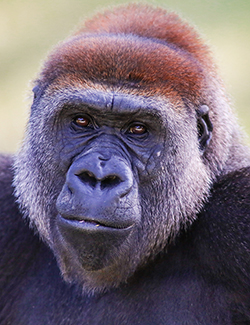
The most Critically Endangered great ape is the Cross River Gorilla, a distinct subspecies that lives only in the fragmented and extraordinarily biodiverse wet highland forests along the border of Nigeria and Cameroon. Shortly after I joined Wildlife Conservation Society in 2002, Professor John Oates gave a talk at the Bronx Zoo about Cross River Gorillas, which he was seeking to study, promote, and save. He said there were about 150 individuals remaining, scattered across 20 forest patches, each group likely genetically isolated from the others. To me, the situation sounded hopeless. But John and his protégés, including Jacquie Groves and many Nigerian and Cameroonian conservationists, found that there were in fact some 300 surviving gorillas and substantial gene flow among the groups—meaning there was hope. In 2008, we worked with the Government of Cameroon and local communities to create Takamanda National Park, immediately adjacent to Cross River National Park in Nigeria, bringing the majority of the population under legal protection, and the population has been stable since.
But several subpopulations of Cross River Gorillas survive in forest patches outside of the two parks, and because every gorilla matters (for so many reasons!), protecting these patches and the ability of the gorillas—especially adolescent males—to transfer between them is among the highest priorities for safeguarding the species. The largest of these patches is Mone River Forest Reserve, a 113,431-acre forest zoned for logging that harbors 40-60 gorillas, as much as 20% of the global population. Mone is 70% intact forest with direct connectivity to Takamanda National Park, and if we don’t act it will likely be leased to a logging company. With support from our donors, a Cameroonian NGO called AJESH will work with the Ministry of Forestry and Wildlife and another partner to create Mone National Park and permanently safeguard the gorillas and the forest.

Protecting the Heart of Borneo
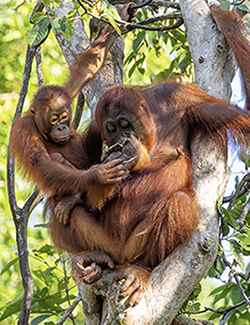
The island of Borneo, divided among Indonesia, Malaysia, and Brunei, has some of the oldest, wettest, and tallest rainforests on Earth, with extraordinary diversity including orangutans, gibbons, and pygmy elephants. Since 1973, over a third of Borneo’s forests have been clear-cut for logging, mining, and especially oil palm cultivation, driving these species to the edge of extinction. Most of the low-lying coastal forests are gone, including many inundated forests with huge peat deposits that have also burned during El Niño years—a terrible double whammy for climate change. During this time period, Bornean Orangutans have declined by almost three-quarters in numbers, leaving the species Critically Endangered and individuals struggling to find a home and food. Rainforest Trust is working hard to save Borneo’s remaining forest, including the central highlands in “the Heart of Borneo” that are now threatened since so few lowland areas remain.
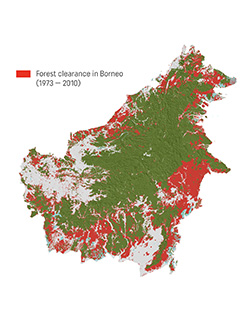
This project will support the Indigenous Dayak communities, assisted by local NGO Yayasan Konservasi Alam Nusantara, to formally establish Indonesian government-recognized customary and village forests across 600,000 acres of intact highland Bornean rainforest, allowing sustainable subsistence agriculture but completely banning industrial logging, mining, and oil palm plantations. This will safeguard habitat and corridors for five globally threatened species that require large tracts of healthy forest to survive, including the Bornean Orangutan.

Bornean Orangutan, by Marketa Myskova
My friends, the world has changed since George Schaller’s heyday in the second half of the 20th century—fewer charismatic species or vast wildernesses remain to be explored. The majority of opportunities to protect large areas of rainforest today come through helping formalize the land rights of Indigenous Peoples and local communities, as in Borneo. But the moral imperative to save nature for the benefit of other sentient species and for our own future has never been greater. And the power of species to rally together communities, governments, and donors to take effective conservation action is undiminished. You and I may not be George Schaller, but we can carry on his mission.
Yours faithfully,
Dr. James C. Deutsch, CEO
Rainforest Trust
Sign up to receive the latest updates
"*" indicates required fields
The Latest
A Message From Our CEO: Carrying on George Schaller’s Mission

Help these 5 Unique Species Survive in Borneo

Rainforest Trust Pledges $50 Million to Advance Conservation Across Commonwealth Nations

Conservation Funders Pledge Initial $12.5 Million Toward Permanent Protection of Guyana’s Forests and Biodiversity

A Heart That Still Beats: The Rediscovery of Mindoro’s Rarest Bird

Rainforest Trust Joins $500 Million Global Alliance to Save the World’s Most Threatened Species

The Little Frog Behind a Big Conservation Story
