

The Chocó Rainforest of Ecuador and Colombia rivals its neighbor the Amazon in biodiversity but is far more threatened. The long-term survival of its myriad species requires the creation and sustained management of large-scale, connected conservation landscapes.
-
Species at Risk
Chiguila Magnolia (CR), Tandayapa Andes Toad (CR), Manduriacu Glassfrog (CR), Black-breasted Puffleg (EN), Brown-headed Spider Monkey (EN), Andean Bear (VU)
-
Carbon stored
N/A*
*(metric tons of CO2 equivalents) -
Partner
11 NGOs
-
1,235,527 Proposed Acres Conserved by
Purchase
-
Project Cost: $35,000,000

1,235,527
The Chocó Rainforest of Ecuador and Colombia rivals its neighbor the Amazon in biodiversity but is far more threatened. The long-term survival of its myriad species requires the creation and sustained management of large-scale, connected conservation landscapes.
-
Species at Risk
Chiguila Magnolia (CR), Tandayapa Andes Toad (CR), Manduriacu Glassfrog (CR), Black-breasted Puffleg (EN), Brown-headed Spider Monkey (EN), Andean Bear (VU)
-
Carbon stored
N/A*
*(metric tons of CO2 equivalents) -
Partner
11 NGOs
-
1,235,527 Proposed Acres Conserved by
Purchase
-
Project Cost: £25,925,925
1,235,527
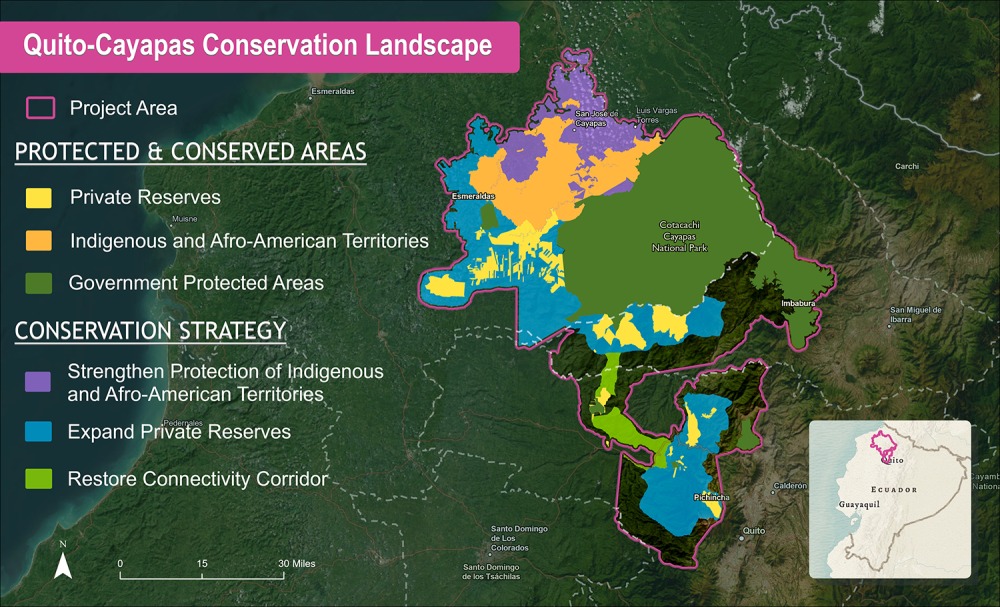
The Chocó Rainforest of Ecuador and Colombia rivals its neighbor the Amazon in biodiversity but is far more threatened. The long-term survival of its myriad species requires the creation and sustained management of large-scale, connected conservation landscapes, including altitudinal migration corridors to allow species to adapt to climate change, and long-term funding from ecotourism and carbon sales.
Eleven Ecuadorian NGOs have partnered to create a plan to conserve the 1,235,527-acre Quito-Cayapas Landscape. They, and several leading biodiversity funders, have asked Rainforest Trust to coordinate their conservation and fundraising. Rainforest Trust seeks to raise $35 million over the next five years for the landscape and the partnership to support land purchase, on-the-ground protection of the forest and species, targeted ecological restoration, and the development of long-term finance. Join us in saving one of Earth’s greatest biodiversity hotspots before it’s too late. Together, we will create a new model of locally-led integrated and sustainable landscape conservation.
Chocó: A Lifeboat for Threatened Species
The Chocó Rainforest of Ecuador, Colombia, and a bit of Panama is extraordinary in both the number of species of all taxonomic groups living here and the percentage of them that live nowhere else (called “endemic”). Rivaling the neighboring Amazon, the Chocó supports:
-
-
- 9,000 vascular plants, a quarter of them endemic, making it perhaps the most floristically diverse site in the Americas,
- More palm species than any other part of the world,
- 830 bird species, of which 85 are endemic,
- 142 mammal species, 15 endemic,
- 350 amphibians species, 210 endemic.
-
Uniquely Under Threat
The Chocó originally spanned 18 million acres from the Pacific Ocean to the Andes Mountains. Today only 2-3% of the Ecuadorian area of the forest remains, and much of that is threatened by both commercial and small-scale logging, mining, and agriculture, and by illegal wildlife trafficking in plants and animals. Protecting the remaining forest and species is complicated by narco-traffickers and insecurity, inadequate management of government protected areas, and lack of community and Indigenous access to funds and technical support.

The Violet-tailed Sylph makes its home in the Quito-Cayapas Landscape, by FotoRequest
A Ray of Hope
Over the past few decades, local and global conservationists in Ecuador and Colombia, recognizing these threats and the extraordinary opportunity to save species in the Chocó, have created conservation non-profits to purchase and manage private nature reserves. Some of these have been extraordinarily successful at halting deforestation and species loss, attracting international tourists (especially birders), and benefiting local communities through employment. Perhaps foremost among these is Fundación Jocotoco, founded by Rainforest Trust President Emeritus Bob Ridgely. Jocotoco’s largest project is the 45,719-acre Canandé Reserve in the Ecuadorian Chocó, which many Rainforest Trust supporters helped create and expand.
From Private Reserves to a Conservation Landscape
Individual private reserves such as Canandé cannot, by themselves, provide a home for all the species of the Chocó nor protect them from long-term threats. Many species are found in the nearby 644,848-acre Cotacachi Cayapas National Park where they are not well-protected; others reside in the neighboring Chachi Indigenous Territory; others still in unprotected forest including two large active industrial logging concessions. Moreover, the existing conservation areas near Canandé are not fully interconnected, and connectivity will be critical if species are to adapt to climate change.
As the world grows warmer, species that can are moving to higher latitudes or higher altitudes to cope with the heat. In the Chocó and the western slopes of the Andes, species are moving uphill some 70-80 meters per decade. The landscape around Canandé and the Cotacachi Cayapas National Park provides an extraordinary opportunity for this climate adaptation as it spans 16,404 altitudinal feet between the lowland Chocó Rainforest and the high Andes Mountains—one of the greatest altitudinal spans of any conservation landscape in the world.

Species and Priority of the Quito-Cayapas Landscape
The landscape harbors 16 Critically Endangered, 58 Endangered, and 83 Vulnerable species, including: Chiguila Magnolia (CR), Tandayapa Andes Toad (CR), Manduriacu Glassfrog (CR), Maquipucuna Rocket Frog (CR), Mindo glassfrog (EN), Mashpi Torrenteer (EN), Tropical Lightbulb Lizard (EN), Two-coloured Fishing Snake (EN), Black-breasted Puffleg (EN), Brown-headed Spider Monkey (EN), and Andean Bear (VU).
More threatened species are found here each year—scores over the past two decades, including a wealth of amphibians and a “species flock” of orchids, but also mammals and birds—not to mention insects.
The Quito-Cayapas Landscape is recognized as a Key Biodiversity Area (KBA), Alliance for Zero Extinction (AZE) site, Species Rarity Site, and Corridor to Mitigate Climate Change. Photo: The Ecuadorian Chocó rainforest, by Ecuadorpostales
A Partnership and a Plan
Jocotoco and ten other local NGOs, including long-term Rainforest Trust partner Fundación EcoMinga, have joined together to reconnect and forever safeguard the Quito-Cayapas Conservation Landscape. They have asked Rainforest Trust to help coordinate their joint conservation work in the landscape, together with local communities including the Chachi Indigenous Peoples and Afro-descendent communities, as well as local and national government. Other major global conservation funders, including the Bobolink Foundation, Liz Claiborne & Art Ortenberg Foundation, Bezos Earth Fund, and Juniper Foundation, have agreed to support the partnership, challenging Rainforest Trust to raise $35 million over the next five years.

Platystele crinita, by Fundacion EcoMinga
Together, the Quito-Cayapas Partnership will:
- Develop and implement a joint landscape conservation strategy engaging local NGOs, communities, government, and local businesses.
- Increase the area of land under permanent legal protection within the landscape from 740,000 to at least 840,000 acres to protect key species, reconnect the landscape, and facilitate altitudinal migration.
- Significantly improve on-the-ground protection, management, and sustainable development across this 1,235,527-acre landscape, including halting deforestation and species decline.
- Begin ecological restoration of 25,000 acres.
- Provide technical support and benefits for local communities, including the Chachi Indigenous Peoples.
- Develop long-term financial mechanisms to support conservation and sustainable development across the landscape, including carbon and biodiversity credits and sustainable ecotourism.
- Investigate options for bilateral and multilateral government financial support.
A New Approach for Rainforest Trust
Rainforest Trust has never before operated at a landscape scale nor taken on responsibility to coordinate multiple on-the-ground partners and global funders. Yet we recognize that safeguarding species and ecosystems over the long term will in due course require us to scale up geographically (from protected areas to landscapes), programmatically (including protected area management and restoration), temporally (eyeing the long-term, including climate change), and financially. We invite you to join us in pioneering a new model of local-led landscape conservation—and in saving one of the world’s greatest and most threatened repositories of biodiversity.
Explore the Chocó Region

Vulnerable Spectacled Bear, also known as the Andean Bear © Burdos

Canandé Reserve in Chocó forest © Jocotoco

Black-breasted Puffleg, by Patricio Mena/Fundación Jocotoco

One of the 13 Critically Endangered or Endangered orchid species in the Alto de Ventanas region.

Brown-headed Spider Monkey

Dracula Orchid

Chocó forest
The Partners
This initiative is a new and innovative model of fundraising and coordination, scaling impact that extends well beyond species and habitat—creating a tapestry of strategically positioned protected and conserved areas backed by sustainable, long-term financing to provide real conservation and climate benefits to the local people and species of this region. The partnership consists of eleven Ecuadorian NGOs, including:
- Aliados
- Aves & Conservación
- Los Cedros (CIPBAT)
- Condesan
- Corporación Toisán
- Fundación EcoMinga
- Fundación Futuro
- Fundación Imaymana
- Fundación Jocotoco
- Fundación Maquipucuna
- Universidad San Francisco de Quito


Conservation work is critical, challenging, and can be costly. We work hard to ensure we raise only the funds needed for each project. In the rare case we raise more money than needed or a project comes in under budget, excess monies will be transferred to the Conservation Action Fund. This fund supports our important conservation work throughout the tropics.
Project Modifications
Rainforest Trust conducts extensive research and due diligence on each of the projects that we support, so that once a project is offered for public support we believe it will succeed. We work closely with our project implementers, offer support, and regularly monitor their progress. Given the nature of the work, projects may not progress exactly as intended and may be unable to meet all objectives. To respond dynamically to the needs of our project implementers and the realities of the landscapes in which they operate, Rainforest Trust expressly reserves the right to modify a project as it deems necessary, provided that donor intent is honored by ensuring that that the original project objectives are diligently pursued and that project funds continue to benefit the landscape and species identified in the project overview. Project modifications that we may need to make in certain circumstances include the specific project implementer, the size of the landscape to be protected, the type of protection to be afforded to the landscape, and the development of sustainability mechanisms.


Sign up to receive the latest updates
"*" indicates required fields